5 Reasons Hydrogen Refueling Is Faster Than EV Charging
Explore why faster refueling, predictable turnaround, and grid independence make hydrogen practical for real-world transportation needs.
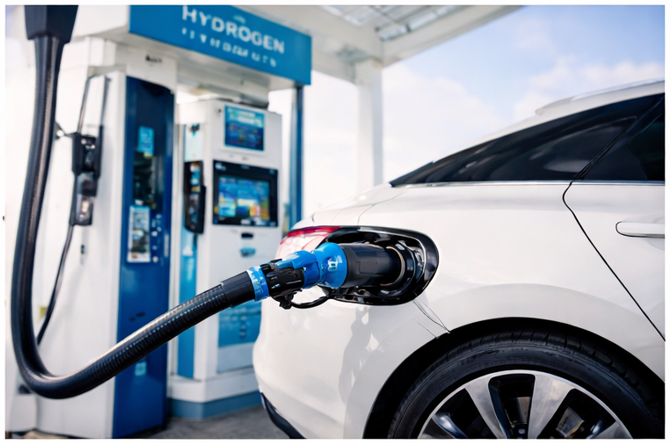
Hydrogen refueling enables fast, reliable energy replenishment for vehicles.
Lost hours, idle vehicles, and shrinking margins, this is the daily reality for high-utilization fleet drivers and operators relying on EV charging. In high-frequency fleet environments (campuses, logistics, industrial mobility), these delays directly constrain asset utilization and operational throughput. Long queues, unpredictable charging times, and grid-dependent infrastructure can halt operations entirely, turning productive hours into dead time. For high-usage vehicles, this delay isn’t just inconvenient; it directly impacts revenue and service reliability.
This challenge also presents a clear opportunity. Hydrogen fuel cell technology offers a fundamentally different approach to energy replenishment, one designed for speed, consistency, and operational continuity. In this article, we explain why hydrogen refueling outperforms EV charging and what this means for real-world mobility. By understanding these differences, readers can better evaluate hydrogen fuel cell vehicles as a practical alternative for time-sensitive use cases.
Here are five technical and operational reasons why hydrogen refueling can be significantly faster than conventional EV charging:
Before we explore each advantage in detail, here’s a quick snapshot of what distinguishes non-compressed hydrogen in commercial mobility:
- High Energy Density Enables Rapid Energy Transfer
- Hydrogen Refueling Mirrors Conventional Fueling Models
- Physical Fuel Transfer Avoids Battery Chemistry Delays
- Predictable Refueling Time Regardless of Vehicle State
- On-Site Fuel Storage Reduces Grid Dependency
Reason 1: High Energy Density Enables Rapid Energy Transfer
Hydrogen contains roughly 120 MJ/kg of energy, significantly higher than lithium-ion batteries, allowing hydrogen fuel cell vehicles to store more usable energy without increasing vehicle weight. This allows hydrogen fuel cell vehicles to store substantial usable energy within compact, lightweight tanks, enabling rapid transfer into the vehicle powertrain without thermal constraints or electrochemical limitations that typically slow energy intake during conventional electric charging cycles and charging curves.
Why does it matter?
- Hydrogen refueling enables predictable turnaround times, preserving asset utilization and operational continuity.
- High energy density minimizes downtime, directly improving fleet productivity and daily revenue potential.
- Faster energy transfer supports high-frequency usage without compromising vehicle availability or performance.
- Reduced waiting periods simplify route planning and improve service reliability.
Reason 2: Hydrogen Refueling Mirrors Conventional Fueling Models

Hydrogen refueling mirrors familiar, fast conventional fueling processes.
According to findings supported by the Hydrogen Council and related industry reports, hydrogen refueling times are highly competitive with conventional fuel dispensing, often ranging from 3 to 5 minutes for light-duty vehicles.
Hydrogen fueling stations are designed to refill vehicle tanks in approximately 3–5 minutes, under standard conditions for light-duty vehicles using conventional hydrogen infrastructure. a process comparable to conventional gasoline refueling. They are engineered to replicate the mechanics of traditional fuel dispensing, using standardized nozzles, automated safety checks, and controlled pressure delivery. This design allows hydrogen fuel cell vehicles to follow a familiar, time-tested refueling sequence, minimizing behavioral change while preserving the speed and reliability expected from legacy fueling infrastructure.
Why does it matter?
- Familiar station design reduces training requirements for drivers and fleet operators.
- Hydrogen refueling maintains fast turnaround times critical for high-utilization vehicles.
- Proven mechanical processes lower operational risk during daily refueling cycles.
- Consistent refueling workflows support smoother large-scale infrastructure deployment.
Reason 3: Physical Fuel Transfer Avoids Battery Chemistry Delays
During EV charging, energy transfer slows as the battery approaches full capacity, a phenomenon known as charge tapering, which significantly increases charging time. Unlike battery charging, which depends on electrochemical reactions within cells, hydrogen refueling relies on the direct physical transfer of hydrogen into onboard storage systems (typically under controlled pressure conditions depending on system architecture compressed gas into onboard storage tanks. This process eliminates charge-rate tapering, thermal management delays, and degradation risks, allowing vehicles to replenish energy rapidly and consistently under varied operating conditions.
Why does it matter?
- Physical fuel transfer removes charging slowdowns caused by battery chemistry limitations.
- Faster turnaround improves fleet uptime and schedule predictability.
- Reduced sensitivity to temperature supports consistent performance across operating environments.
- Shorter refueling cycles directly enhance vehicle availability and service output.
Reason 4: Predictable Refueling Time Regardless of Vehicle State
With hydrogen refueling, fill times remain stable regardless of tank level, pressure variance, or prior vehicle usage. Unlike battery charging curves that slow near capacity, hydrogen systems follow standardized protocols that deliver consistent refueling durations, enabling operators to plan vehicle turnaround with high accuracy across daily operational cycles. For high-utilization fleets such as delivery vehicles, forklifts, or autonomous transport systems, consistent refueling time is critical for maintaining tight operational schedules.
Why does it matter?
- Predictable refueling supports precise scheduling across high-frequency fleet operations.
- Consistent turnaround reduces idle vehicle time and improves asset utilization.
- Stable refueling durations simplify route planning and dispatch coordination.
- Operational predictability directly strengthens hydrogen fuel efficiency metrics.
Reason 5: On-Site Fuel Storage Reduces Grid Dependency
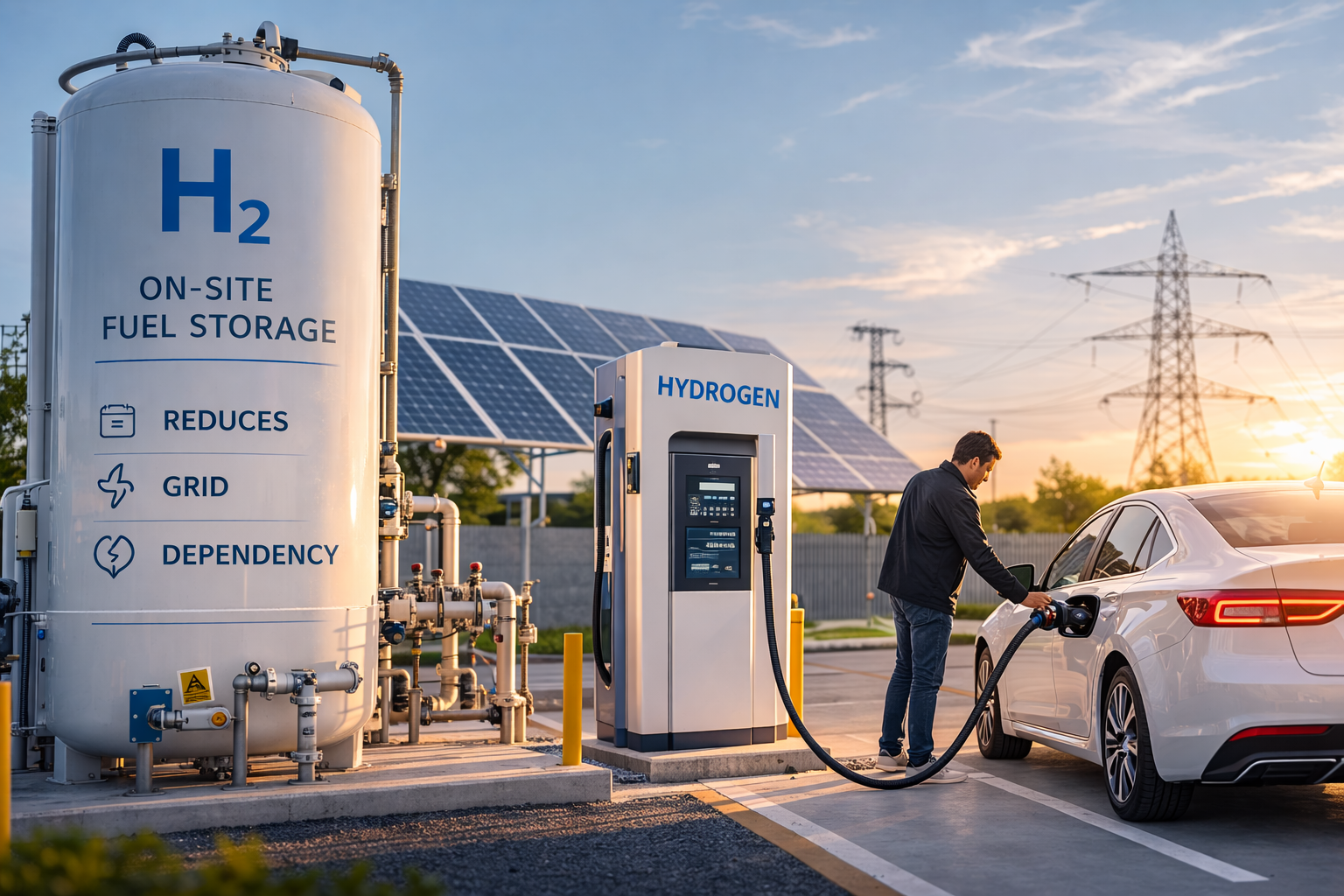
On-site hydrogen storage reduces grid dependency for refueling stations.
Some hydrogen infrastructure models allow on-site hydrogen generation and storage including decentralized models using bio-based hydrogen production and localized refilling systems, allowing operators to maintain refueling capacity even during peak electricity demand periods. This architecture decouples refueling capacity from electrical peak loads, ensuring uninterrupted operations even when grid availability is constrained or unstable.
Why does it matter?
- Reduced grid reliance protects operations from outages and power-quality disruptions.
- On-site storage ensures consistent fuel availability during peak demand periods.
- Energy independence improves operational resilience for critical mobility applications.
- Self-sufficient systems strengthen long-term hydrogen fuel efficiency economics.
Why Fast Hydrogen Refueling Matters for High-Uptime Mobility
Embracing hydrogen fuel cells represents a decisive shift for modern transportation systems, particularly for high-usage and time-sensitive operations. By eliminating long waiting periods through fast, predictable hydrogen refueling, businesses can reduce downtime, stabilize operations, and improve profitability while supporting sustainability goals. As adoption increases, hydrogen fuel cell vehicles emerge as a viable alternative where uptime, speed, and operational continuity are non-negotiable.
For fleets and mobility operators, fast refueling must also be supported by reliable infrastructure. HyZero addresses several operational challenges by designing hydrogen systems that support high-throughput refueling environments.
| Challenge | HyZero Solution | Benefit |
|---|---|---|
| Long vehicle downtime | High-flow hydrogen dispensing systems | Faster turnaround and improved asset utilization |
| Unpredictable refueling times | Standardized refueling protocols | Reliable scheduling and operational consistency |
| Grid dependency | On-site hydrogen storage and supply systems | Resilient operations during grid constraints |
| Infrastructure scalability | Modular, scalable station architecture | Cost-efficient expansion aligned with demand |
| Fleet productivity loss | Integrated hydrogen ecosystem design | Higher uptime and sustained revenue potential |
Learn how hydrogen infrastructure can support faster, more reliable mobility systems and experience a revolutionary approach to refueling that maximizes your operational efficiency!
Summary at a Glance
- Leverage high energy density to enable rapid energy transfer for vehicles.
- Utilize familiar fueling models that enhance user comfort in adopting hydrogen.
- Minimize delays caused by battery chemistry through direct gas transfers.
- Ensure predictable refueling times to optimize scheduling and reduce idle times.
- Establish on-site fuel storage solutions to mitigate grid dependency.
FAQs
1. Will switching to hydrogen disrupt daily operations and driver routines?
Many operators worry that adopting new energy systems will slow workflows. In reality, hydrogen refueling closely follows familiar fueling processes, allowing drivers to refuel quickly without retraining or operational disruption. With support from HyZero, transitions are structured to preserve uptime from day one.
2. Is the technology reliable enough for high-usage commercial fleets?
Uncertainty often stems from concerns about consistency and vehicle availability. Hydrogen fuel cell vehicles are designed for predictable refueling cycles, avoiding the variability seen in battery charging. HyZero’s infrastructure focuses on stable pressure control and on-site storage, ensuring dependable performance even during peak operating hours.
3. Will infrastructure limitations reduce long-term scalability and profitability?
A common fear is becoming dependent on fragile energy networks. HyZero addresses this by enabling hydrogen refueling with on-site storage, reducing grid reliance and operational risk. For fleets deploying hydrogen fuel cell vehicles, this model supports scalable growth while maintaining fast turnaround and cost control as demand increases.
Build Faster, Smarter Mobility Systems With HyZero Leading Hydrogen Infrastructure
HyZero enables organizations to move beyond charging delays and operational bottlenecks. Its hydrogen-focused approach aligns speed, reliability, and scalability with real-world mobility demands.
- 3–5 minute refueling cycles
- 300–400 mile operational range
- On-site, grid-independent fuel storage
- Infrastructure built for fleet throughput
Back your zero-emission strategy with proven hydrogen systems, partner with HyZero to deploy fast refueling, resilient infrastructure, and future-ready mobility at scale.
Powered by MarketEngine from StartupWind