5 Ways Hydrogen Fuel Cell Technology Is Transforming Three-Wheelers
Unlock longer range, faster refueling, and zero emissions with hydrogen fuel cell technology for next-gen three-wheelers.
Three-wheelers are at the heart of urban mobility, but challenges are mounting. Fuel costs rise, pollution chokes our cities, and conventional EVs can’t keep up, they charge slowly, travel short distances, and cost a fortune. Drivers struggle to finish routes, and fleets face downtime and rising expenses. Hydrogen fuel cell technology changes the game, offering fast refueling, longer range, and lower operating costs to give drivers and fleets the edge they need.
OEMs (Original Equipment Manufacturers), and fleet operators adopting this technology early can gain first-mover advantages such as higher cost reduction margins, sustainability leadership, and improved ROI.
Before we explore each game-changing benefit in detail, here’s a quick snapshot of how fuel cell technology is transforming three-wheelers:
- Extended Range Eliminates Downtime
- Faster Refueling Means More Uptime
- Lower Total Cost of Ownership
- Zero Emissions, Real Sustainability
- Safe, Scalable Energy Infrastructure
Each of these benefits plays a crucial role in helping OEMs and fleet operators modernize operations while delivering practical advantages for drivers.
Let’s now dive in to uncover each one of these benefits more closely.
#1. Extended Range for Maximum Uptime
What is it?
Hydrogen fuel cell vehicles generate electricity from hydrogen, enabling daily driving ranges of 120–150 km, compared to ~75 km for conventional EVs.
Why does it matter?
A longer range minimizes downtime caused by charging, allowing drivers to complete more trips in a single shift and increase income. Fleet operators benefit from consistent uptime and optimized route planning. Fewer vehicles are required to cover the same service area, reducing fleet investment costs and improving overall efficiency. Hydrogen fuel cell systems, built on innovative fuel cell technology, are the future of 3 wheelers, giving drivers the extended range they need for maximum uptime.
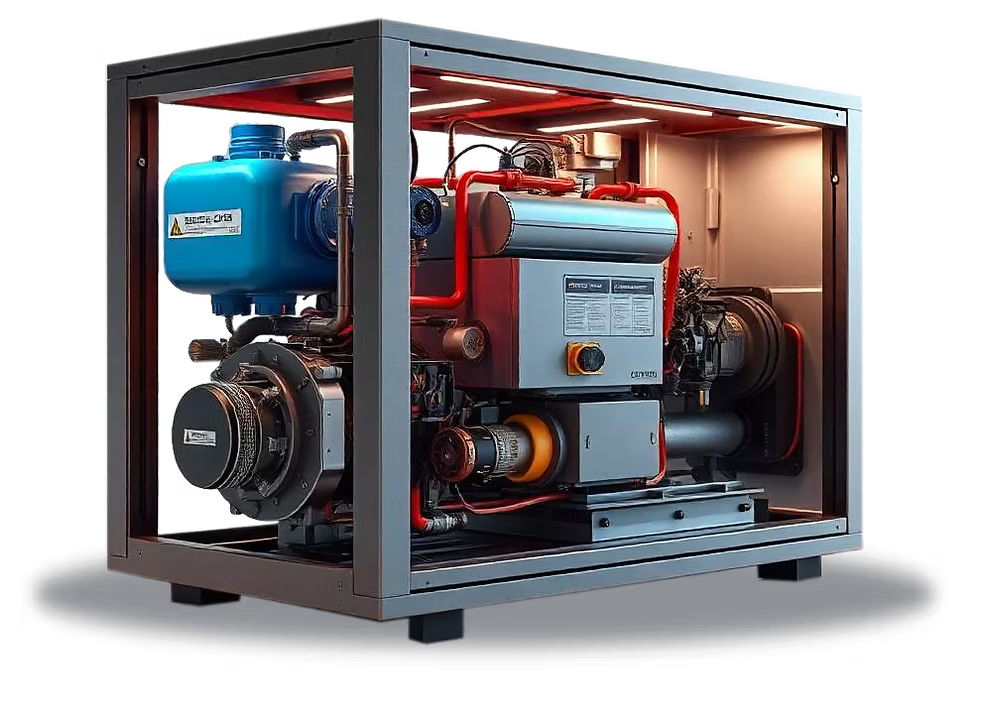
Inside view of a hydrogen fuel cell delivering sustainable power for three-wheelers.
Real world example:
In real‑world testing, hydrogen fuel‑cell vehicles have shown ranges up to 650‑800 km from just 5‑6 kg of hydrogen, or ~85 km per kg of H₂ in three‑wheeler baseline trials, highlighting the strong range potential compared with typical EVs.
In real‑world testing, hydrogen fuel‑cell vehicles have shown ranges up to 650‑800 km from just 5‑6 kg of hydrogen, or ~85 km per kg of H₂ in three‑wheeler baseline trials, highlighting the strong range potential compared with typical EVs.
Pro Tip:
Use modular fuel cell designs, leveraging fuel cell technology, to align vehicle range with fleet needs.Hydrogen technology innovators like HyZero offer a complete hydrogen fuel cell ecosystem , combining engines, cartridges, and refueling infrastructure, to enable fleets to deploy hydrogen vehicles efficiently and scale operations without over-engineering systems.
#2. Fast Refueling: Back on the Road in Minutes
What is it?
Three-wheelers equipped with hydrogen fuel cell technology can be refueled quickly using cartridges or through a hydrogen delivery system , providing a faster alternative to conventional EV charging.
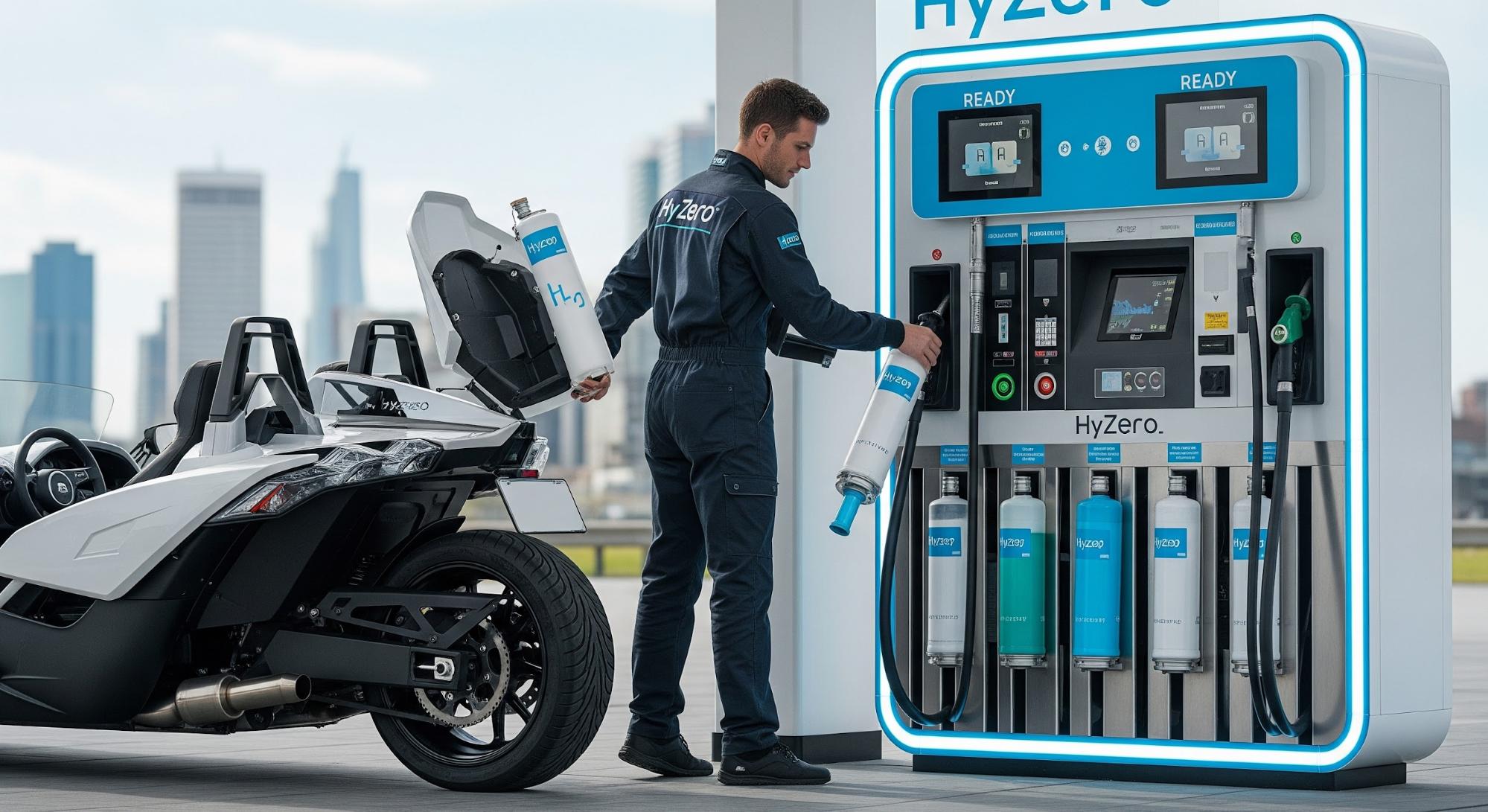
Driver swaps hydrogen fuel cartridges in minutes at a HyZero station, keeping three-wheelers on the road longer.
Why does it matter?
Every lost minute off the road hits profits. EVs require long charging windows, which reduce trips and driver income. Hydrogen powered vehicles return to service almost immediately, maximizing daily revenue, reducing fleet idle time, and dramatically improving ROI. This speed advantage alone can make or break high-utilization fleets. Hydrogen mobility, powered by fuel cell technology, solves the range problem, allowing drivers to keep running without downtime worries.
Real world example:
In fleet trials conducted in the U.S., hydrogen-powered vehicles were refuelled extremely quickly, averaging just 3.4 minutes per refill. In fact, 87% of all refuelling events took less than 5 minutes, allowing fleets to stay on the road longer and spend minimal time idling at stations, according to data from the U.S. Department of Energy’s National Renewable Energy Laboratory (NREL).
In fleet trials conducted in the U.S., hydrogen-powered vehicles were refuelled extremely quickly, averaging just 3.4 minutes per refill. In fact, 87% of all refuelling events took less than 5 minutes, allowing fleets to stay on the road longer and spend minimal time idling at stations, according to data from the U.S. Department of Energy’s National Renewable Energy Laboratory (NREL).
Pro Tip:
Deploy distributed cartridge refill points close to high-traffic routes to maximize vehicle uptime. Unlike conventional hydrogen solutions that rely on centralized refueling hubs, localized modular refueling ensures vehicles spend less time off the road and more time generating revenue.
#3. Cut Costs, Boost ROI: Lower Total Cost of Ownership
What is it?
Hydrogen powered vehicles equipped with next-generation fuel cell technology lower long-term operating costs by reducing fuel expenses, minimizing charging infrastructure needs, and cutting maintenance requirements.
Why does it matter?
CNG fleets can spend up to 30% of revenue on fuel alone. Hydrogen cuts that in half, or more while slashing maintenance costs. Operators see faster payback and higher net profit, gaining a competitive advantage over fleets that lag in adoption.
Real word example:
A 3 kW HyZero fuel cell has been successfully deployed on a leading OEM auto-rickshaw (October 2025), demonstrating readiness for commercial operations and proving real-world viability.
A 3 kW HyZero fuel cell has been successfully deployed on a leading OEM auto-rickshaw (October 2025), demonstrating readiness for commercial operations and proving real-world viability.
Pro Tip:
Combine local hydrogen generation with plug-and-play cartridge systems to cut fuel costs and minimize operational complexity. Compared to CNG or fragmented EV fleets, this approach reduces reliance on external fuel suppliers, lowers maintenance requirements, and ensures predictable long-term cost savings.
#4. Go Green Without Compromise: Zero Emissions, Real Sustainability
What is it?
Fuel cells generate electricity using hydrogen, producing only water vapor, making three-wheelers completely emission-free.
Why does it matter?
Urban pollution is costly, not just to the environment, but to public health and regulatory compliance. Hydrogen vehicles eliminate this liability while positioning fleets as eco-leaders, unlocking subsidies, tax breaks, and positive branding. Fleets that fail to adopt risk reputational damage and missed government incentives. Emission-free power solutions give fleets a clear advantage in sustainability and compliance.
Real world example:
A study covering 15 G20 countries found that aggressive adoption of hydrogen fuel‑cell vehicles could significantly cut greenhouse‑gas emissions compared to conventional transport fleets, highlighting the real-world sustainability impact of hydrogen mobility.
A study covering 15 G20 countries found that aggressive adoption of hydrogen fuel‑cell vehicles could significantly cut greenhouse‑gas emissions compared to conventional transport fleets, highlighting the real-world sustainability impact of hydrogen mobility.
Pro Tip:
Adopt hydrogen powered vehicles (three-wheelers) using fuel cell technology early to capitalize on sustainability programs, tax credits, and green fleet branding. Unlike typical EV fleets limited by long charging times, or CNG fleets that emit pollutants, hydrogen-powered three-wheelers deliver measurable environmental benefits while maintaining high operational efficiency.
#5. Safe, Scalable Energy Infrastructure
What is it?
Next-gen fuel cell technology operates at atmospheric pressure, making it safer and easier to store, transport, and use compared to compressed hydrogen systems.
Complete Hydrogen Fuel Ecosystem for 3-Wheelers
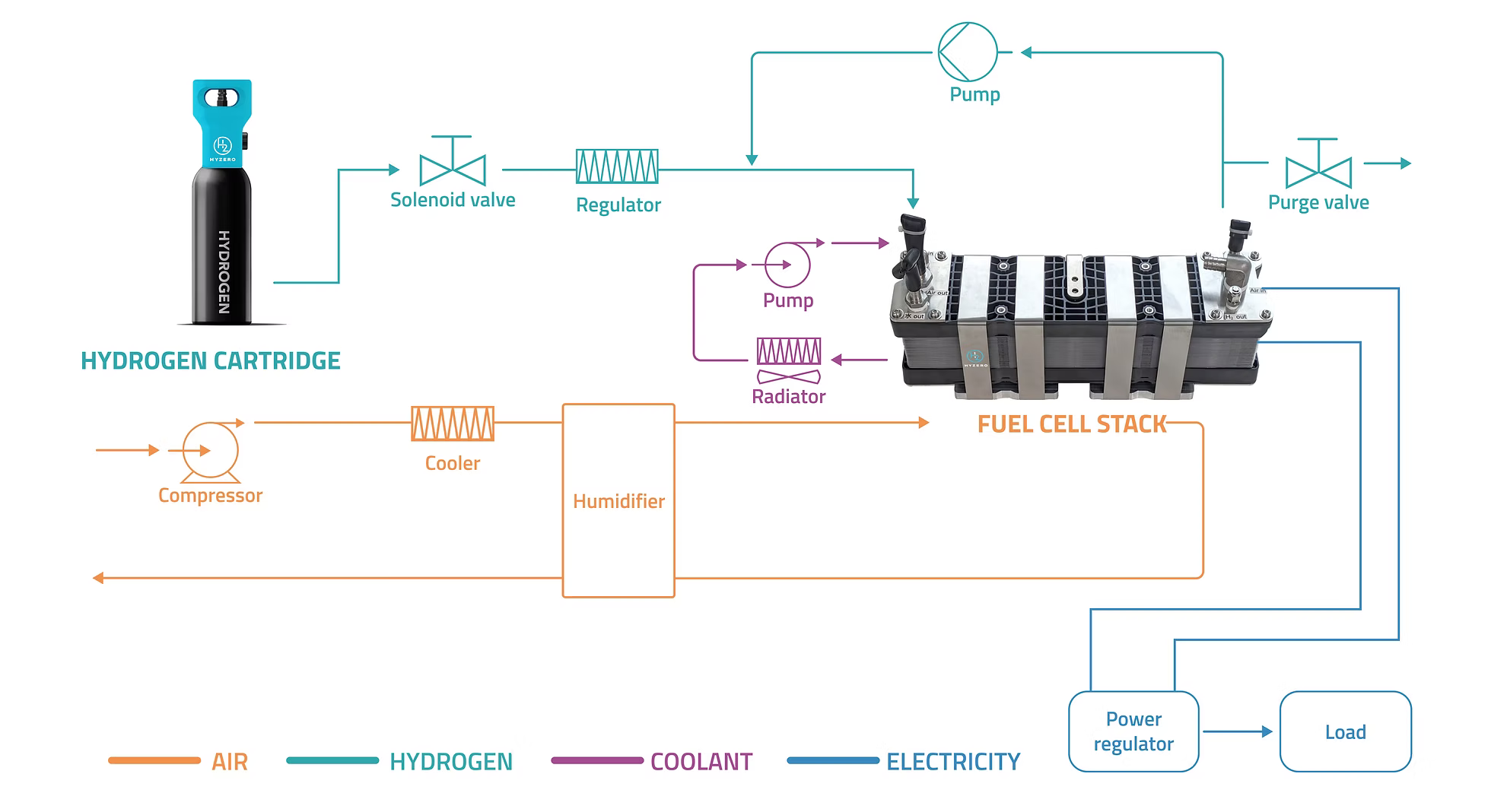
HyZero’s complete hydrogen fuel cell ecosystem, from engines and cartridges to refilling stations and bio-hydrogen production.
Why does it matter?
Traditional hydrogen systems have been costly and complex to implement. By removing the need for compression and liquification, OEMs can build scalable, cost-efficient infrastructure without compromising safety. Proof-of-concept and pilot programs become more accessible to smaller players. Modular, atmospheric-pressure hydrogen delivery and refueling systems represent a new standard in mobility solutions enabling fleets to expand rapidly and safely.
Real world example:
HyZero’s expanded core team is driving advanced R&D (Research & Development), and commercialization efforts, while the Mahindra Treo proof-of-concept undergoes system homologation with ARAI and PESO, enabling fleets to scale hydrogen mobility efficiently.
HyZero’s expanded core team is driving advanced R&D (Research & Development), and commercialization efforts, while the Mahindra Treo proof-of-concept undergoes system homologation with ARAI and PESO, enabling fleets to scale hydrogen mobility efficiently.
Pro Tip:
Build modular, atmospheric-pressure hydrogen delivery and refueling systems using advanced fuel cell technology to simplify scale-up. Unlike conventional US hydrogen setups requiring high-pressure compression, modular infrastructure reduces safety risks, deployment costs, and operational delays, enabling fleet operators to expand rapidly.
Key Takeaway
The hydrogen fuel cell vehicle market, valued at USD 1.5B in 2024 is projected to grow at 27.2% CAGR in between 2025–2034 Hydrogen fuel cells deliver longer range, faster refueling, lower costs, and zero emissions. Real-world pilots like HyZero’s 3 kW fuel cell on a leading OEM auto-rickshaw prove commercial readiness. Early adoption gives fleets and OEMs a clear competitive advantage.
Hydrogen Fuel Cell Vehicle Market Global Forecast (2025 - 2034)
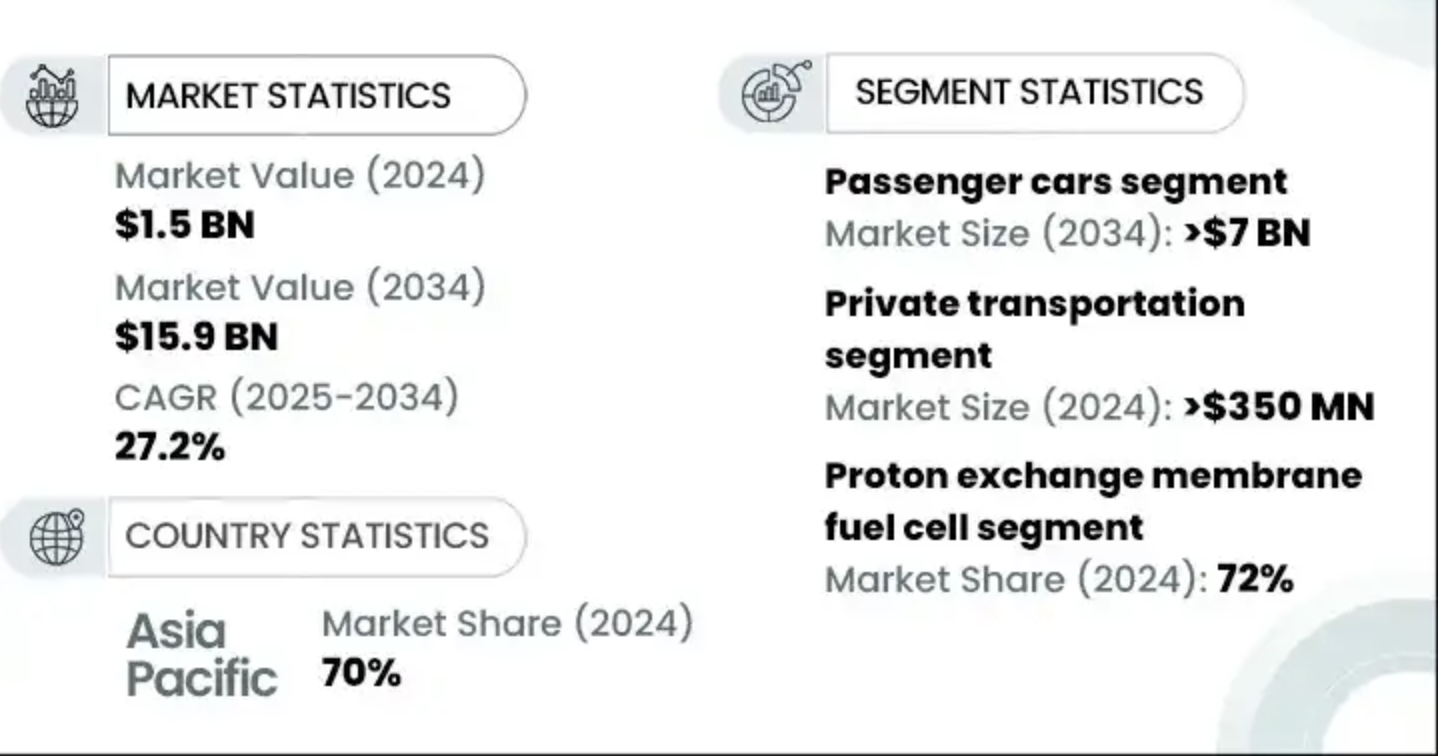
Hydrogen fuel cell market set for rapid growth, led by Asia Pacific and key segments like passenger cars and PEM fuel cells.
TL;DR
- Longer Range: Hydrogen powered vehicles travel farther than EVs or CNG.
- Quick Refueling: Back on the road in under 10 minutes.
- Proven in Action: HyZero’s 3 kW fuel cell demonstrates real-world readiness.
- First-Mover Advantage: Early adopters save costs and lead in sustainability.
- Scalable Systems: Modular, safe infrastructure fits fleets of any size.
The Market Is Already Moving From Promise to Proof
Hydrogen mobility, powered by advanced fuel cell technology, is no longer a concept, it’s ready for real-world operations. OEMs and fleet operators who act now can maximize uptime, cut costs, and lead the shift to sustainable, emission-free transport.
Future-proof your fleet with hydrogen fuel cells, faster, cleaner, more efficient.
FAQs
What is fuel cell technology and how does it work?
Fuel cell technology uses hydrogen to generate electricity, producing only water
vapor as a by-product. This makes it a clean, efficient, and sustainable power
source for three-wheelers and other mobility segments.
Are hydrogen powered vehicles safe to operate?
Yes. Modern fuel cell systems operate at normal atmospheric pressure, eliminating
the risks associated with compressed hydrogen storage. This makes them safer and
easier to integrate for OEMs.
How do hydrogen fuel cell vehicles compare to electric vehicles?
Unlike EVs that require long charging times, hydrogen vehicles powered by fuel cell
technology offer fast refueling, longer range, and lower total operating costs,
making them ideal for high-utilization vehicles like three-wheelers.
What kind of infrastructure is needed for hydrogen three-wheelers?
A simple setup of cartridge refilling stations and local hydrogen generation systems
can support efficient operation of hydrogen fuel cell vehicles, ensuring reliable
daily service without requiring massive infrastructure investments.
How can manufacturers or fleet operators get started with hydrogen
mobility?
OEMs can explore rapid proof-of-concept or pilot programs with integrated hydrogen
fuel cell solutions. Companies like HyZero provide complete ecosystem support,
including fuel cell systems, cartridges, and refueling infrastructure.
What is fuel cell technology and how does it work?
Fuel cell technology uses hydrogen to generate electricity, producing only water vapor as a by-product. This makes it a clean, efficient, and sustainable power source for three-wheelers and other mobility segments.
Are hydrogen powered vehicles safe to operate?
Yes. Modern fuel cell systems operate at normal atmospheric pressure, eliminating the risks associated with compressed hydrogen storage. This makes them safer and easier to integrate for OEMs.
How do hydrogen fuel cell vehicles compare to electric vehicles?
Unlike EVs that require long charging times, hydrogen vehicles powered by fuel cell technology offer fast refueling, longer range, and lower total operating costs, making them ideal for high-utilization vehicles like three-wheelers.
What kind of infrastructure is needed for hydrogen three-wheelers?
A simple setup of cartridge refilling stations and local hydrogen generation systems can support efficient operation of hydrogen fuel cell vehicles, ensuring reliable daily service without requiring massive infrastructure investments.
How can manufacturers or fleet operators get started with hydrogen mobility?
OEMs can explore rapid proof-of-concept or pilot programs with integrated hydrogen fuel cell solutions. Companies like HyZero provide complete ecosystem support, including fuel cell systems, cartridges, and refueling infrastructure.
Powered by MarketEngine from StartupWind